
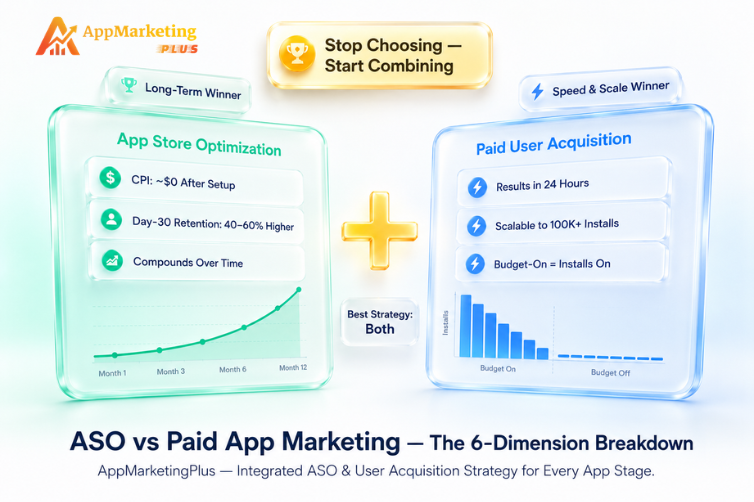
Every app developer faces the same budget allocation question: should I invest in ASO vs paid app marketing, or both? The answer determines your cost-per-install, your user quality, your long-term growth trajectory, and ultimately your app’s profitability. This comparison breaks down ASO vs paid app marketing across six key dimensions — cost, speed, user quality, scalability, sustainability, and compounding returns — using data from 2025 and early 2026 campaigns managed by our mobile app marketing agency. The goal is a clear, evidence-based framework for allocating your app growth budget.
Understanding ASO vs Paid App Marketing at the Core
App store optimization services improve your app’s store listing to rank higher organically and convert more visitors into installs. Cost-per-install from organic traffic is effectively zero — you pay for optimization work once, and those improvements generate installs indefinitely. Paid app marketing covers user acquisition on Google App Campaigns, Meta app install ads, TikTok app ads, and Apple Search Ads. You pay for each install; when your budget stops, so do the installs. Understanding the ASO vs paid app marketing distinction is the essential first step toward rational growth strategy.
The Core Economic Difference in ASO vs Paid App Marketing
ASO is a fixed-cost investment: you pay for keyword research, metadata optimization, creative assets, and ongoing management once, then those optimizations generate installs without additional per-install cost. Paid UA is variable-cost: every install costs money, and as campaigns scale or competition increases, CPI typically rises. In 2025, average iOS app install CPI was $3.12 in the US (AppsFlyer data); in competitive categories like fintech it can exceed $20. Against near-zero marginal cost for organic ASO installs, the long-term economics are stark.
ASO vs Paid App Marketing — Six-Dimension Comparison
Dimension 1: Cost Per Install
ASO organic: ~$0 marginal CPI after optimization investment. Paid UA: $1–$25+ per install depending on category and market. For apps with strong LTV, paid UA can be very profitable — but it requires LTV to exceed CPI significantly.
Dimension 2: Speed to Results
Paid UA wins on speed. A well-configured Google App Campaign generates installs within 24 hours. App store optimization services typically take 4–12 weeks to show meaningful ranking movement. For apps with time-sensitive launch windows, paid UA is the necessary tool. Our UA service launches campaigns in days →
Dimension 3: User Quality and Retention
This is where ASO consistently outperforms paid acquisition. Organic users retain at 40–60% higher rates at day-30 compared to paid install users (multiple independent studies, 2024–2025). A user who searched for your specific app category is a far more qualified prospect than one interrupted by an ad while scrolling social media.
Dimension 4: Scalability
Paid UA wins on scalability ceiling. With sufficient budget, campaigns scale to hundreds of thousands of installs per month. ASO is bounded by search volume of target keywords. For apps pursuing rapid scale with aggressive growth targets, paid UA is the necessary tool. Our mobile app marketing agency designs scalable strategies →
Dimension 5: Sustainability
ASO wins decisively on sustainability. Once your app achieves strong organic rankings, they provide a stable install baseline without ongoing spend. Paid UA is inherently unsustainable at scale: as competition increases, CPI rises; as creative ages, performance decays; as budgets pause, installs stop immediately.
Dimension 6: Compounding Returns
ASO generates compounding returns; paid UA does not. Each improvement — better keywords, stronger creatives, more reviews — builds on the previous round. The ASO flywheel, once spinning, accelerates over time. Paid UA does not compound: spend $10k, get $10k of installs. Spend $0, get $0 installs.
The Winning Strategy in ASO vs Paid App Marketing
The winning answer to ASO vs paid app marketing is always both — deployed strategically at each stage. Early stage (0–1,000 installs): heavy ASO investment, light paid UA for data collection. Growth stage (1,000–50,000 installs): scaled paid UA using ASO’s conversion-optimized listing. Mature stage (50,000+ installs): ASO maintains organic baseline; paid UA for specific growth initiatives and retargeting. Our combined ASO and UA packages deliver both strategies together →
How Paid UA Feeds ASO Performance — The Key Insight
Most developers miss this: a well-run paid campaign drives download velocity — a positive ranking signal. More paid installs generate more reviews, which improve your rating and conversion rate, which improve your organic ranking. The most sophisticated app marketers use paid campaigns strategically to accelerate ASO momentum in the ASO vs paid app marketing equation — not as a permanent alternative to it.
Frequently Asked Questions: ASO vs Paid App Marketing
Q: With a limited budget, should I choose ASO or paid ads?
With limited budget, prioritize ASO. The investment is front-loaded but returns are permanent. A $1,000 ASO investment improving your organic ranking will generate installs for years; the same $1,000 in paid ads generates installs for weeks.
See our affordable ASO packages →
Q: Can I run both ASO and paid marketing simultaneously?
Absolutely — and this is the recommended approach. The key is sequencing: optimize your listing fully before scaling paid spend. A well-optimized listing improves paid campaign performance by increasing the conversion rate of paid traffic, effectively reducing your CPI.
Q: Which platform is better for paid app marketing — Google or Meta?
It depends on your app category. Google App Campaigns work exceptionally well for utility and productivity apps. Meta works better for games and lifestyle apps. TikTok is increasingly effective for under-35 audiences. Our mobile app marketing agency identifies the best channel mix for your app →
Conclusion: Stop Choosing Between ASO vs Paid App Marketing
The most successful apps in 2026 do not choose between ASO vs paid app marketing — they integrate both strategically. App store optimization services build a compounding organic foundation that reduces blended CPI over time. Paid UA provides speed, scale, and velocity signals that feed back into ASO performance. Together, they create a growth engine that neither approach can build alone. AppMarketingPlus specializes in integrated ASO and paid UA strategies tailored to your app’s specific stage, category, and budget. Get a free growth strategy consultation → and discover the right balance of ASO vs paid app marketing for your situation.