
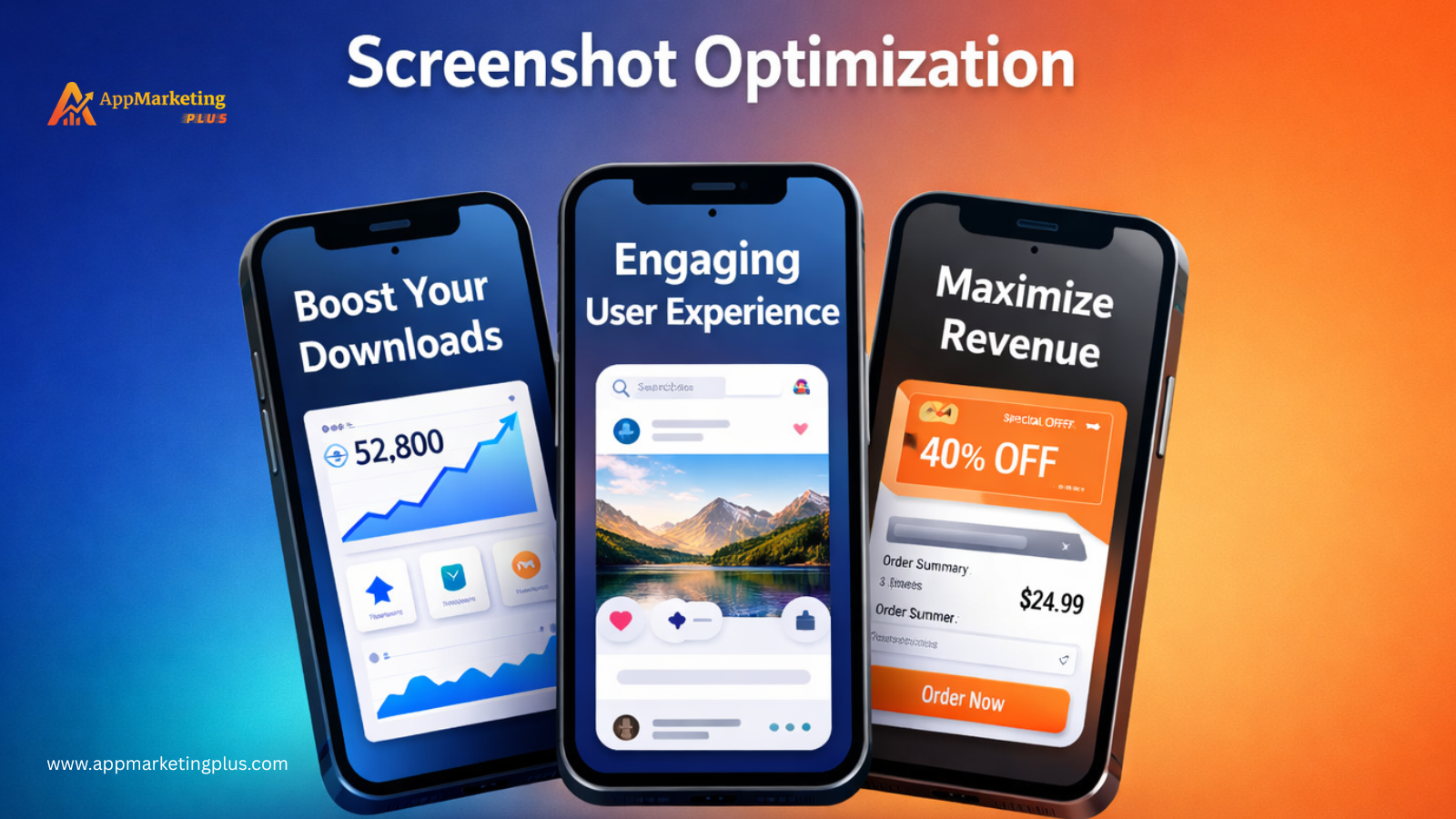
Your app has seconds to make a first impression. When a potential user lands on your App Store listing, screenshots are the single most influential visual element determining whether they tap “Download” or scroll past. Studies show that over 60% of users browse screenshots before reading a single word of your app description — yet most developers treat screenshots as an afterthought.
That’s a costly mistake.
App Store screenshot optimization is the systematic process of designing, sequencing, and testing your app’s screenshots to maximize conversion rates. Done correctly, it can increase installs by 25–35% without changing a single line of code or spending an extra dollar on paid acquisition. It’s one of the highest-leverage actions in your entire app store optimization strategy.
In this guide, you’ll learn exactly how to create screenshots that stop thumbs, communicate value instantly, and convert browsers into loyal users — on both the Apple App Store and Google Play Store
Why App Store Screenshots Matter More Than You Think
The Visual Hierarchy of App Store Listings
When users arrive at your listing, their eyes follow a predictable path: app icon → ratings → screenshots → description. The screenshots zone is where the majority of conversion decisions happen. This means your screenshots aren’t decorative — they’re your most powerful sales tool.
According to data from Storemaven, the average user spends fewer than 7 seconds evaluating an app listing before deciding to install or leave. In that window, your screenshots need to communicate your app’s core value proposition, establish trust, and create desire — all simultaneously.
For apps in competitive categories like productivity, health, or gaming, a 1% improvement in conversion rate can translate to thousands of additional downloads monthly. That’s why leading app publishers invest significantly in screenshot A/B testing, design iteration, and performance tracking through their mobile app marketing services.
Screenshots vs. App Preview Videos
Many developers debate whether to prioritize screenshots or app preview videos. The answer is both — but screenshots always come first. On the App Store, screenshots display before video thumbnails for most users. On Google Play, screenshots appear prominently in the main gallery. Videos require a tap to play; screenshots communicate instantly.
Use screenshots as your primary conversion driver and videos as supplementary proof.
Technical Specifications: Getting the Basics Right
Apple App Store Screenshot Requirements
Apple requires screenshots for each device type you support. Here are the critical specs:
- iPhone 6.9″ (iPhone 15 Pro Max): 1320 × 2868 px — now required
- iPhone 6.7″: 1290 × 2796 px
- iPhone 5.5″: 1242 × 2208 px (still widely used for older devices)
- iPad Pro 12.9″: 2048 × 2732 px (required if supporting iPad)
You can upload up to 10 screenshots per device type. Always provide screenshots for the largest required screen size — Apple will use these to generate previews for smaller devices.
Google Play Store Screenshot Requirements
- Minimum size: 320 px on any side
- Maximum size: 3840 px on any side
- Format: JPEG or PNG (24-bit, no alpha)
- Quantity: 2 screenshots minimum, up to 8
Google Play also features a prominent “Feature Graphic” banner (1024 × 500 px) at the top of your listing — treat this as a bonus screenshot opportunity with a headline and key visual.
Getting these specs right is foundational, but it’s only the beginning of true screenshot optimization
Design Principles That Drive Conversions
Lead With Your Strongest Value Proposition
Your first screenshot is the most important. It must answer one question instantly: “What does this app do for me?”
Avoid generic UI screenshots. Instead, use a bold headline overlay that states the core benefit, paired with a device mockup showing the most impressive or unique feature. Think: “Track Every Expense in Seconds” over a clean dashboard view, rather than a plain interface screenshot with no context.
The first screenshot should function like a billboard — readable at a glance, compelling from a distance, and immediately clear in its promise
Tell a Story Across Your Screenshot Sequence
Think of your screenshot sequence as a mini sales narrative. Each image should build on the previous one:
- Screenshot 1: Core value proposition — the “why”
- Screenshot 2: Key feature #1 — the “what”
- Screenshot 3: Key feature #2 — social proof or differentiation
- Screenshot 4: Key feature #3 — solving the user’s pain point
- Screenshot 5: Trust signal — ratings, awards, or user count
- Screenshots 6–10: Additional features, testimonials, or use cases
This narrative arc guides users through a micro sales funnel within the listing itself, dramatically increasing the likelihood of conversion
Typography and Color Psychology
Text overlays on screenshots should be large, bold, and immediately legible at thumbnail size. A common mistake is using font sizes that look fine on desktop mockups but become unreadable in App Store search results. Test your screenshots at 30% size — if the text isn’t still readable, increase the font size.
Color psychology matters too. High-contrast color combinations (dark text on light backgrounds or vice versa) perform consistently better than low-contrast designs. Use your brand colors consistently across all screenshots to build visual cohesion and brand recognition
Platform-Specific Optimization Strategies
Apple App Store: Leveraging the First Three Screenshots
On the Apple App Store, when your app appears in search results, only the first three screenshots (or the first one in landscape mode for games) are visible without tapping. This makes your first three screenshots disproportionately important.
Treat these three as a complete story. Users who see only these three should understand your app’s core value, its top feature, and why it’s worth downloading. Save detailed feature breakdowns for screenshots 4–10.
Also leverage Apple’s App Store product page optimization (PPO) feature, which allows you to test up to three alternate sets of screenshots with different user segments. This built-in A/B testing tool is invaluable for data-driven screenshot optimization.
Google Play: Maximizing the Feature Graphic
On Google Play, the Feature Graphic banner appears prominently at the top of your listing and in certain promotional placements. Unlike screenshots, the Feature Graphic doesn’t show app UI — it’s a pure marketing asset.
Use it to display your app name, tagline, and a compelling visual (such as a lifestyle image or 3D app mockup). Keep text minimal and impactful. A strong Feature Graphic can significantly boost click-through from category browsing and featured placements, which connects directly to your broader app pre-launch services and go-to-market strategy
A/B Testing Screenshots: A Data-Driven Approach
What to Test First
Not all screenshot elements have equal impact. Prioritize testing in this order:
- First screenshot headline copy — largest impact on conversion
- Background color scheme — affects emotional response and brand perception
- Device mockup style — flat vs. 3D vs. lifestyle photography
- Screenshot sequence order — which features to lead with
- Caption length and style — short punchy vs. descriptive subtitles
Tools for Screenshot A/B Testing
Several platforms specialize in pre-deployment screenshot testing, including Storemaven, SplitMetrics, and TestNest. These tools simulate App Store environments and measure conversion intent before you publish changes — eliminating guesswork from your optimization process.
For live testing, use Apple’s Product Page Optimization and Google Play’s Store Listing Experiments. Both offer statistically valid A/B testing with real user traffic, giving you reliable conversion data. Working with a professional app store optimization agency can help you interpret test results and build a sustained iteration cadence
Common Screenshot Optimization Mistakes
Even experienced developers fall into predictable traps:
Mistake 1: Using raw UI screenshots with no context. A plain app screen with no headline or callout tells users nothing about the benefit. Always add caption overlays.
Mistake 2: Inconsistent visual style across screenshots. Mismatched colors, fonts, or device mockups create a disjointed, unprofessional impression. Establish a visual template and apply it consistently.
Mistake 3: Ignoring localization. If you’re targeting non-English markets, translated screenshots consistently outperform English originals. Text overlays, in particular, must be localized for each major target market.
Mistake 4: Never testing. Many developers publish screenshots once and never revisit them. Treat screenshots as living assets that require ongoing optimization as your market evolves, competitors enter, and app features change.
Mistake 5: Forgetting about iPad. If your app supports iPad, Apple requires separate iPad screenshots. Neglecting these means Apple may not surface your app in iPad-specific searches — a significant missed opportunity
Frequently Asked Questions
How many screenshots should I upload to the App Store?
Upload the maximum allowed — 10 for the Apple App Store and 8 for Google Play. More screenshots give you more storytelling real estate. Even if early screenshots drive most conversions, highly engaged users often browse all available screenshots before installing.
Should my screenshots show real app UI or marketing graphics?
Both. The most effective screenshots combine real app UI within a device mockup, overlaid with a benefit-focused headline. Pure marketing graphics without UI can feel misleading; pure UI screenshots without context miss the persuasion opportunity.
How often should I update my screenshots?
Review your screenshots at minimum every quarter, and definitely after major feature updates, seasonal campaigns, or when you notice a drop in conversion rate. Fresh screenshots also signal active development, which can positively influence App Store editorial consideration.
Do screenshots affect App Store search rankings?
Screenshots don’t directly affect keyword rankings, but they strongly influence conversion rate — and conversion rate is a significant ranking signal for both Apple and Google algorithms. Better screenshots → more installs → improved ranking. The impact is indirect but very real.
What’s the biggest single change I can make to improve screenshot performance?
In most cases, rewriting the first screenshot headline delivers the biggest immediate lift. Most apps use generic headlines like “The Best [Category] App.” Replace this with a specific, benefit-focused statement addressing the user’s primary pain point, and you’ll typically see measurable conversion improvement within days of publishing.
Conclusion
App Store screenshot optimization is one of the most underutilized levers in mobile app growth. While most developers focus their energy on paid acquisition and feature development, a strategic overhaul of your screenshots can deliver significant conversion gains with minimal ongoing cost.
Start by auditing your current screenshots against the principles in this guide. Ask yourself: Does my first screenshot instantly communicate core value? Does the sequence tell a compelling story? Have I ever run an A/B test? For most apps, the answer reveals enormous untapped potential.
If you’re ready to take a comprehensive approach to app growth — from screenshot optimization to full-funnel marketing — explore our mobile app marketing packages or contact our team for a personalized strategy session. Your next thousand installs might be one great screenshot away